
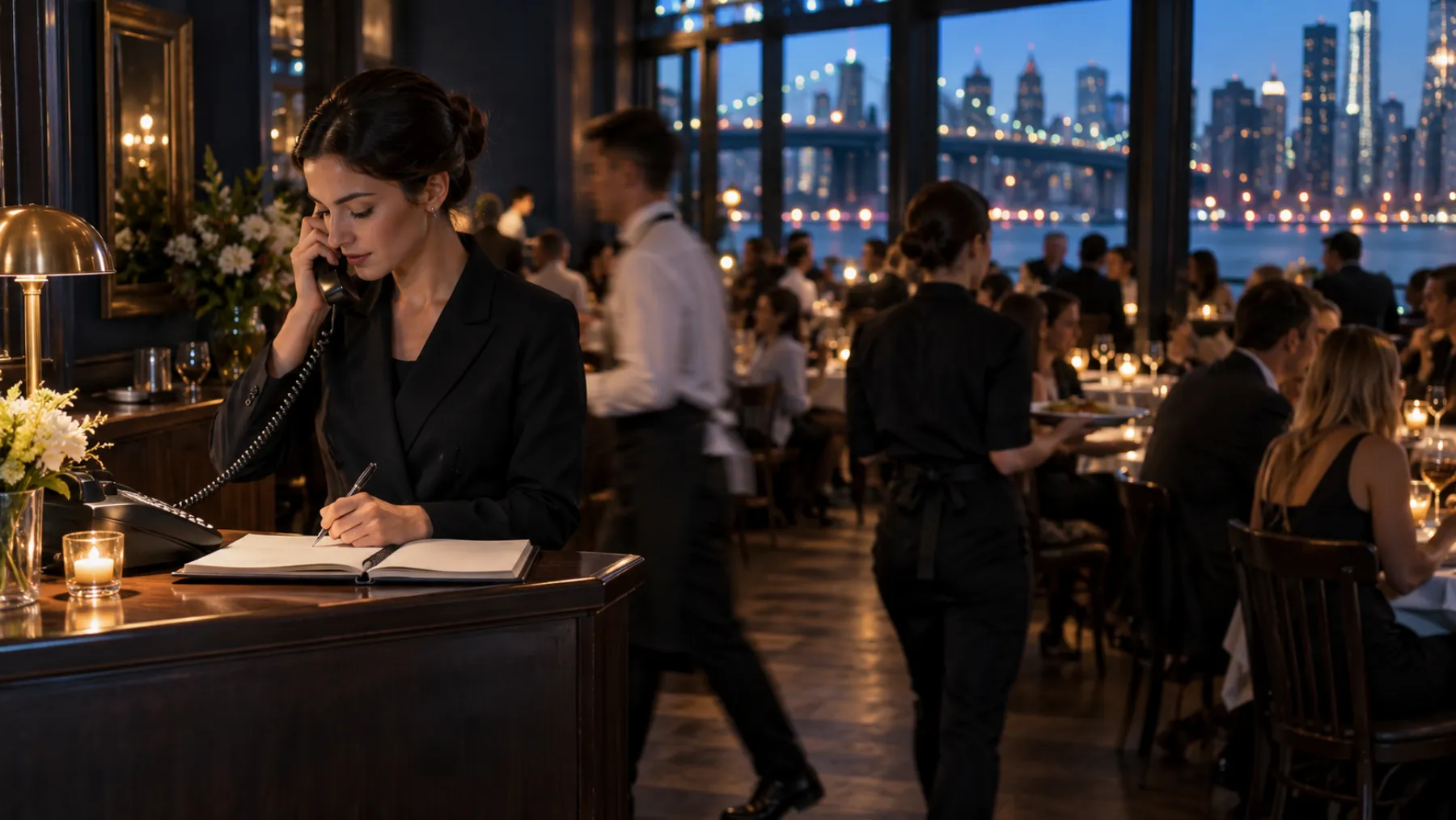
It is 7:40 on a Friday evening. The dining room is full, the kitchen is calling tickets, and the host is seating a party at the door. The phone rings, then rings again. Nobody can answer it, so the caller tries the next restaurant on their list. AI phone answering for restaurants is built for exactly this moment: an agent picks up during service, takes the booking or order, and texts the guest a confirmation before the line goes quiet.
The agent answers every call during service. It takes reservations and waitlist requests, answers menu questions from the menu you supply, records takeaway orders for the kitchen, and passes private events and large parties to the manager. It texts a confirmation to the guest. Anything it is unsure about goes to a person, with the call summary attached.
Which calls does a restaurant get during service?
Most calls during service fall into a short list. Each one is quick on its own, but together they keep the host away from the guests standing in front of them. The restaurants page shows how this fits a dining room day:
- Reservations for a set time and party size.
- Waitlist questions, such as how long the wait is.
- Opening hours, parking and directions.
- Menu questions, including vegetarian options and allergens.
- Takeaway orders and collection times.
- Changes and cancellations to an existing booking.
- Private dining and large groups.
How does a reservation call work?
Reservations are the call to get right first, because every missed one is a table that stays empty. The agent follows a simple order:
- Confirm the date, the time and the number of guests.
- Check your booking book or reservation system for a free table at that time. Where no connection exists, the agent takes the request and tells the guest the restaurant will confirm.
- If the time is full, offer the nearest alternative. For example: "We have 7:15 or 9:30. Which suits you better?"
- Take a name and a mobile number, and note any occasion or seating request.
- Text the confirmation, with the time, the address and a line on how to change or cancel.
The aim is a confirmed table at the end of the call, not a promise to call back. The rules for slot length, buffers and double bookings work the same way as in appointment booking. The table below shows where each common call type ends up:
| Call | What the agent does | When it goes to staff |
|---|---|---|
| Table for four at 8pm | Checks availability and confirms by text | Only when no table is free and there is no waitlist |
| Party of twelve or a private room | Takes the details and passes them on | Always |
| Menu or allergen question | Answers from the menu you provide | When the answer is missing or unclear |
| Takeaway order | Records items, name and pickup time | When an item has sold out |
| Complaint about a meal | Records it and apologises | Always |
Can the agent answer allergen questions?
Allergen questions are where a restaurant needs a firm rule rather than a good guess. A guest with a nut allergy asks whether a dish contains peanuts. The agent may answer only from the allergen notes you have supplied for that dish. If the notes are missing, out of date or do not cover the question, the agent says it does not know, takes the guest's number and passes the call to a member of staff. It never guesses.
The agent is only as accurate as the notes it has. Review them when a supplier changes, when a recipe changes and before each new menu goes live.
How are takeaway orders passed to the kitchen?
Takeaway orders are easy to get wrong on a busy night. The agent reads back each item, the size, any changes such as no onion, the name and the pickup time before it confirms. If your till system is connected, the order goes straight to the kitchen screen. If it is not, the order goes to the queue your team already uses, and your staff check it before it is cooked.
If an item has sold out, the agent says so and offers the closest alternative from the menu you have set. It does not invent one.
What should happen with private events and large groups?
Large parties and private events need a conversation, not a standard booking. The agent takes the date, the number of guests, the occasion and a contact number. It then tells the caller that the manager will be in touch. It does not quote prices for private hire, deposits or set menus. The manager receives the full details and makes those calls. For how a summary reaches a person without the guest repeating themselves, see warm handoff.
Confirmations and cancellations
Text messages do two jobs. They confirm the booking, and they let guests move or cancel without calling again. A good confirmation holds the date, the time, the party size, the address and one line on how to change it. Send it straight away, while the guest is still thinking about the table. A cancellation during service can be offered to the waitlist, so the table is not left empty. For the text channel itself, see SMS for customer messages.
What do missed calls cost at peak times?
Here is an illustrative example with round numbers, not a survey result. A restaurant misses 10 calls during a two-hour dinner rush. If two of those callers would have booked a table for four, that is eight covers, meaning eight guests, gone from one evening. Repeat the pattern on a busy Friday and Saturday, and the missed bookings add up quickly.
To work out your own figure, count the calls you miss during service for one week. Then estimate the covers and the spend each one would have brought. Your numbers will differ from the example, and the sum is more useful than any rule of thumb.
How VoiFlow handles this
VoiFlow's agents answer on the first ring, including during service, and can switch between the languages their callers speak. Where a connection exists, the agent checks the booking book, confirms by SMS or WhatsApp, and saves a summary of each call for staff to review. The permissions and limits you set decide what the agent may book. Anything the agent cannot answer from your menu notes goes to your team.
Frequently asked questions
Will a caller know they are speaking to an AI?
If a caller asks whether they are speaking to a person or an AI, the agent says it is an AI assistant. It never claims to be a person. Disclosure rules vary by country and must be followed, so check what applies where you operate.
Can the agent take payment for takeaway orders?
Payment depends on how your restaurant is set up. The simplest arrangement takes payment at pickup or online, so the agent does not need to hear any card details on the call. Check the options with your payment provider before you switch on takeaway calls.
What happens when the restaurant is fully booked?
The agent offers the nearest free time, adds the guest to the waitlist if you use one, and tells the guest how they will be told if a table opens. It does not book a table you do not have.
Does the agent answer on busy nights?
It picks up on the first ring, whatever the time, so a guest is not left ringing while the host is busy. The guest hears the same answer whether it is quiet or the dining room is full.
If your restaurant loses calls during service, write down the five calls you take most often, the menu notes you already keep and the times you are fully booked. Try a live call to hear how the agent handles a booking, or contact us to talk through a pilot for your restaurant.